
Sweet Kitchen Tips 12

The holidays are coming up and any help in organizing yourself during the chaos is helpful. And most of us bake up a storm of cookies, cakes and breads. So by being a bit “ahead of the game” it will not feel like a mad rush. By doing this simple step, you can save some major time during a baking marathon.

Measure out and label the ingredients for each recipe ahead of time, storing the dry ingredients in zipper-lock bags on the counter and wet ingredients in plastic containers in the refrigerator. When it’s time to bake, everything is ready to be mixed.

And since the first holiday that is up its thanksgiving, then its turkey time!

You want to turn that turkey around in the oven? But know that your oven mitts will get dirty in the process… but, I got a tip for you.  Slip a clean plastic product bags over your oven mitts.  The plastic will keep the mitts from getting greasy, and there no chance of burning your hands.

And if you are ready to move that bird from the roasting rack to your carving board without it becoming a precarious maneuver, all you need is two long-handled wooden spoons.  Insert the bowl ends of the spoons into either the end of the bird’s cavity so that the handles stick out.  Graps the handles, really choking up on them so your hands are right next to the turkey, and lift the bird off the rack to your board.

FFwD: Marie-Helene's Apple Cake

The apple is the most cultivated tree fruit and the most used by humans.  There are more than 7,500 known variety of apples. The United States grows 2,500 of these, but just 100 of them are grown commercially. Apples are grown in 36 U.S. states, but six states — Washington, New York, Michigan, California, Pennsylvania and Virginia — produce the vast majority.  

Want to impress your friends with your uncanny knowledge of this autumn favorite?

  • Apples float because 25 percent of their volume is air.

  • It takes nearly 40 apples to make 1 gallon of cider.

  • You could eat a different apple every day for more than 19 years, and never eat the same kind twice!

  • The “Delicious” apple variety is the most widely grown variety in the United States.

  • An apple tree has to grow for four or five years before it will produce an apple.

  • Bobbing for apples started as a Celtic New Year’s tradition to determine whom you would marry.

  • In ancient times, apples were thrown at weddings (instead of rice or birdseed, like today … ouch!).

  • The apple belongs to the rose family.

When you Google “apple recipes” you are bound to get more than 40,900,000 hits.  There are a lot of people using a lot apples out there.

Read More

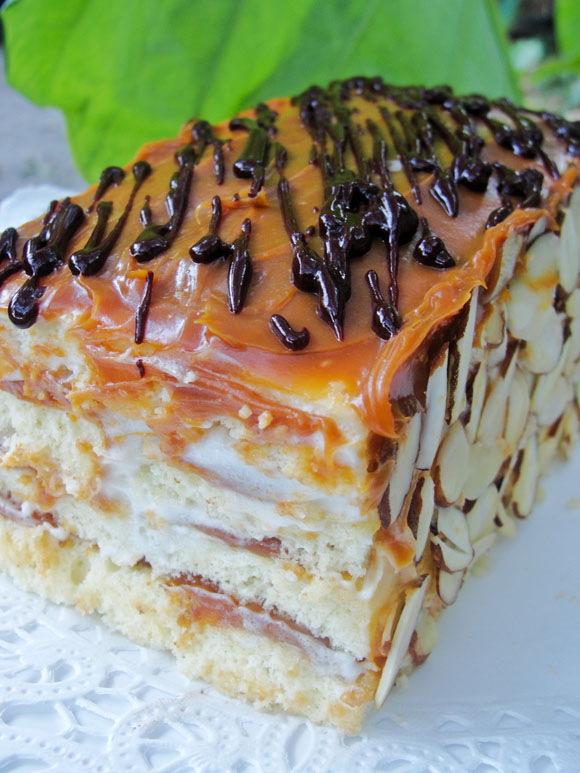
Dulce de Leche Stacked Cake

Argentineans have a fantastic story about the origins of dulce de leche.  They claim that in a war, in their country, in the early nineteenth century, on a winter afternoon, General Lavalle and General Manuel de Rosas came together in order to make a treaty. The General Lavalle arrived very tired at the camp of General Manuel de Rosas. Manuel de Rosas wasn’t in the camp at the moment so General Lavalle entered into his tent and took a nap.

While the General Lavalle was napping a serving woman was preparing “la lechada” for the camp. “La lechada” is prepared by heating sugar and milk. The woman went to speak with the General Manuel de Rosas in his tent, but when she entered she discovered the enemy. She didn’t know about the treaty the two generals were about to make, so she ran to find soldiers.

The General Manuel de Rosas arrived moments before the soldiers, and stopped them from waking the sleeping General Lavalle. In the chaos, the woman forgot about “la lechada.”

When she remembered and checked on “la lechada,” she noticed that it had become a dark brown jelly substance. It is said that a very brave and hungry soldier tried the jelly and then dulce de leche was born. 

It’s a great story, but others claim that it dulce de leche most likely originated with the French “confiture de lait”, a confections very similar to dulce de leche that was created - coincidentally? - in the fourteenth century in a similar military culinary accident.

Who to believe?

Read More